Last updated: September 2026
Quick verdict
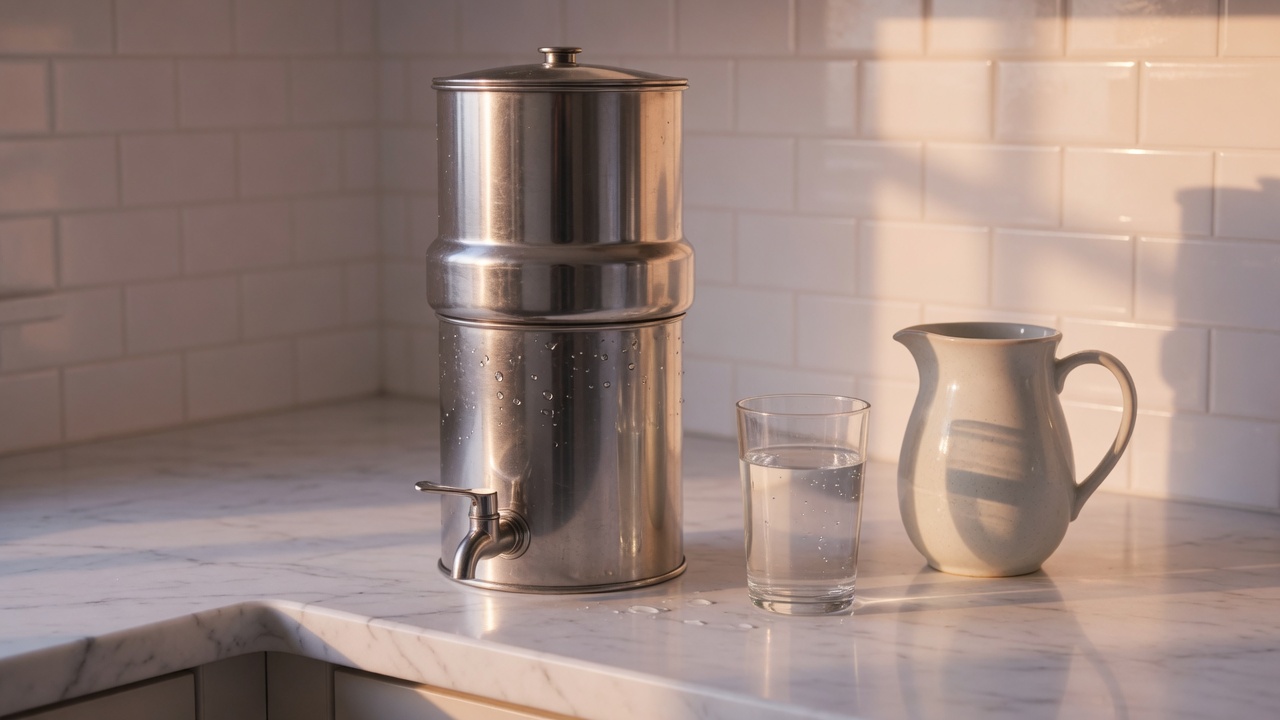
Yes, if you want filtered water stored in steel, not a plastic pitcher. The Legacy is a 3-gallon gravity can: 304 stainless upper and lower chambers, stainless spigot. WQA-certified to NSF/ANSI 42, 401, and 372. About $355-400. That is the pick in our plastic-free water filters roundup.
A plastic pitcher that “filters microplastics” is a half-swap. The cartridge may catch particles. The water then sits in plastic. Columbia researchers reported in 2024 that a liter of bottled water can hold on the order of 240,000 tiny plastic fragments, most of them nanoplastics. Tap is cleaner than that, and still not empty. (Columbia Climate School, 2024)
This can is the other half of the swap: gravity, no plumber, filtered water in stainless. I compared Boroux’s spec sheet, the WQA performance data, WIRED’s 2026 steel-filter test, and current listings. I have not run this can in this kitchen. Where I say it is slow, or that chlorine drops, that is their test and WIRED’s, not a glass I timed.
Product details
Two stacked 304 stainless chambers. Pour tap in the top. Gravity pulls it through two Foundation carbon filters (model BX-FND9-2) into the lower chamber. Spigot at the bottom: stainless, ceramic valve. Three gallons. Assembled it stands about 23 inches tall and 9 inches wide. Nest it and it drops to about 15 inches. A stand adds six inches so a mug fits under the tap.
WQA Gold Seal to NSF/ANSI 42 (Class I particulates), NSF/ANSI/CAN 401 (microplastics in the 0.5-1.0 µm band), and NSF/ANSI/CAN 372 (lead-free materials). The official sheet is 98.9% reduction on that particle challenge. That is not a nanoplastics cert. It is not NSF 53. Lead, PFAS, chlorine, and the rest of the “80+” list are IAPMO third-party sheets, not the Gold Seal. Read them as lab work, not the same as Culligan’s full cert stack.
Kits now include an automatic primer (USB-C). Filters are carbon with silver as an antimicrobial for the carbon itself. Boroux is careful not to sell this as a well-water or pond filter. Lifetime warranty on the steel chambers, spigot, washers, plugs, and wingnuts. One year on the Foundation filters. Street price is usually $355-400 for the two-filter can. Direct: boroux.com.
A 1.8-gallon Compact exists if the 3-gallon tower does not fit. Fluoride is a separate add-on in stainless shells. The Foundation pair does not do that job.
Where the water sits
The water you drink sits in 304 stainless. The spigot is steel. That is why this page exists, and why a Brita tank does not.
The honest asterisk: the Foundation elements are carbon in a sleeved cartridge. Stem Savers and hole plugs are BPA-free plastic. They live in the upper chamber, on the unfiltered side. Silicone gaskets seal the rest. This site will live with silicone. See Is silicone safe?. WIRED’s plastic score on this can was the same idea: unfiltered water can see a little plastic. Filtered water should not.
BPA-free on those plugs is not a gold star. We covered the swap chemistry in BPA-free bottles. You are not storing the drink in the plug.
Drawbacks
- It is a tower. Two feet tall. Full, it is more than 25 pounds. WIRED filled it in the sink and did not love carrying it back. Most people will fill it with a pitcher, overnight.
- It is slow. Brand rate with two filters is about 1 gallon per hour. WIRED needed more than three hours for a full tank. Plan on an overnight refill, not a glass in two minutes.
- The Gold Seal is narrow. Particulates, that microplastics band, lead-free metal. If you need a certified PFAS or lead reduction sheet on the can itself, that is the Culligan MaxClear column in the roundup. You pay for it in filter cost and wait.
- Setup is a project the first time. Carbon filters ship dry. Prime them, run a first batch, dump the grey water. Current kits include the automatic primer so you are not doing it with a faucet and a mess. WIRED still called the first hour tedious. After that it is a can you fill.
- It will not hide in the fridge. Room-temp water unless you pour it into glass and chill it. Boroux sells a borosilicate pitcher for that. Or use a bottle you already own.
Which one to buy
The one: Boroux Legacy, 3-gallon, two Foundation filters. Polished steel. Skip the painted colors if you do not want to worry about chips at the lid.
If you already read the plastic-free filter roundup, this is the deep dive on the Best Overall pick. The older microplastics filter guide is still the NSF-401 map, including the plastic-housing RO testers like. Bottled water numbers: microplastics in bottled water.
Who should skip it
- You want the longest certified contaminant list on a gravity can. Buy Culligan MaxClear and live with the slow ceramic and the replacement cost.
- You need fluoride off the tap. Add Boroux’s fluoride shells, or pick a different machine. The Foundation pair is not that filter.
- You only drink a mug a day and you do not want a 23-inch object on the counter. The Compact is 1.8 gallons. A glass carafe RO is a different job.
- Your water is not potable. This is not a microbiological purifier. Boroux says so on the sheet.
The Bottom Line
The Legacy is the gravity filter to buy if the job is clean water that sits in steel. Stainless chambers, stainless spigot, WQA seal for particles and the 0.5-1.0 µm microplastics band. About four hundred dollars. It is tall, it is slow, and the first setup is work. Fill it at night. If you need the full cert stack, that is Culligan. If you need RO numbers and will drink from glass, that is AquaTru Carafe, housing still plastic. Do not buy a new Berkey black-element kit while the EPA stop-sale holds.
Related: Best plastic-free water filters · Filters for microplastics · Plastic-free kitchen
This article contains affiliate links. If you buy through them, we may earn a commission at no extra cost to you. I only link products I would actually recommend on the materials.
Leave a Reply