Last updated: February 2026 · Written by the No Plastic Living team
📦 Quick Answer
The best water filter for microplastics in 2026 is the AquaTru Carafe – a countertop reverse osmosis system with a glass carafe that’s IAPMO certified to NSF/ANSI 401 for microplastics reduction. It eliminated 100% of contaminants in independent testing, needs no installation, and won’t reintroduce plastics through a plastic tank. If you need something more affordable, the Clearly Filtered Pitcher ($80-$100) removes 99.9% of microplastics and targets 365+ contaminants total.
Here’s an uncomfortable truth: the water you’re drinking right now almost certainly contains tiny plastic particles. Whether it comes from your tap or a fancy bottle, microplastics have infiltrated our drinking water supply at levels that scientists are only beginning to fully understand.
A landmark 2024 study from Columbia University found that a single liter of bottled water contains roughly 240,000 tiny plastic particles – about 90% of which are nanoplastics so small they can cross cell membranes and enter your bloodstream. That’s 10 to 100 times more than previous estimates. The World Health Organization has acknowledged the presence of microplastics in drinking water, and researchers are now calling for formal regulation. The science is clear: this isn’t a hypothetical problem. It’s in your glass right now.
The good news? The right water filter can remove virtually all microplastics from your drinking water. But here’s the catch – not all filters are created equal. That basic pitcher filter sitting on your counter? It’s probably not cutting it. In this guide, we’ll break down exactly which filter technologies actually work, which ones don’t, and recommend the best options for every budget and living situation.
The Microplastics Problem: What’s Actually in Your Water?
Microplastics are plastic fragments smaller than 5 millimeters. Nanoplastics are even tinier – under 1 micrometer – and they’re the ones scientists are most worried about. They come from degrading plastic waste, synthetic clothing fibers, industrial runoff, and even the plastic pipes that carry your water.
The numbers are staggering. A 2024 study published in Proceedings of the National Academy of Sciences by Columbia University researchers used a new laser-based technique to detect nanoplastics that previous methods missed. They found 110,000 to 370,000 plastic fragments per liter of bottled water. The most common types? Polyamide (likely from water treatment filters themselves), polystyrene, polyethylene, and PET.
Tap water isn’t safe either. Studies have detected microplastics in tap water samples from every continent. A 2024 analysis published in Science of the Total Environment tracked microplastics from source water through treatment plants and into the tap, finding that conventional water treatment removes some but not all particles. The WHO’s 2019 report on microplastics in drinking water acknowledged the widespread contamination, though it noted that health research was still emerging.
The health implications are still being studied, but early research is concerning. Microplastics have been found in human blood, lung tissue, and placentas. They can carry chemical additives like phthalates and BPA, and may act as vehicles for other contaminants. Researchers at Rutgers and Columbia are actively investigating what happens when these particles enter human tissues at the cellular level.
Which Water Filters Actually Remove Microplastics?
Not all filtration methods are equal when it comes to microplastics. Here’s what the science says:
Reverse Osmosis (RO) – The Gold Standard
Reverse osmosis pushes water through a semi-permeable membrane with pores as small as 0.0001 microns. Since most microplastics are larger than 1 micron, RO systems capture over 99% of microplastic particles. Studies confirm that RO membranes are the most effective point-of-use technology for microplastic removal. If budget and installation aren’t barriers, this is your best option.
Activated Carbon Block Filters
Dense carbon block filters (not the same as loose granular carbon) can trap many microplastic particles. High-quality carbon block filters with tight pore structures can capture particles down to 0.5 microns. They’re less effective than RO against the smallest nanoplastics, but a well-designed carbon block system can still remove a significant portion of microplastics. Look for filters with sub-micron ratings.
Gravity-Fed Ceramic Filters
Ceramic filters, like those used in British Berkefeld systems, use a porous ceramic element that physically blocks particles. The Ultra Sterasyl filter element, for example, is NSF certified for microplastics reduction. These are a solid option if you want filtration without electricity or plumbing.
What Does NOT Work for Microplastics
Let’s be direct about what won’t protect you:
- Standard Brita-style pitchers with basic granular activated carbon filters have pores that are too large to reliably catch microplastics. The standard Brita Everyday pitcher uses loose granular carbon that lets most particles pass through.
- Refrigerator filters are typically basic carbon filters designed mainly for taste and odor. They’re not engineered for particle removal at the micron level.
- Faucet-mounted filters (basic models) usually lack the filtration density needed. Some premium faucet filters can help, but most won’t make a meaningful dent.
- UV purifiers kill bacteria and viruses but do nothing to physically remove plastic particles.
- Water softeners deal with mineral content, not plastic contamination.
NSF Certification: What to Look For
When shopping for a microplastics water filter, certifications are your best friend. Here’s what matters:
NSF/ANSI 401 is the key standard. It covers “emerging contaminants” including microplastics (as well as pharmaceuticals and other compounds). A filter certified to NSF 401 has been independently tested and verified to reduce microplastics. This is the certification you want to see on the box.
NSF/ANSI P473 covers PFAS/PFOA reduction – not microplastics specifically, but it indicates advanced filtration capability and is often found alongside NSF 401 in high-performing filters.
NSF/ANSI 42 covers aesthetic effects (taste, odor, chlorine), while NSF/ANSI 53 covers health-related contaminants (lead, VOCs, cysts). NSF/ANSI 58 is the standard for reverse osmosis systems. A filter with certifications across multiple NSF standards is generally a better, more thoroughly tested product.
The certification must come from an accredited third-party lab – organizations like NSF International, IAPMO, or WQA. If a manufacturer claims microplastic removal but can’t point to an independent certification, treat that claim with skepticism.
Our Top 6 Water Filter Picks for Microplastic Removal
We evaluated dozens of water filters based on their microplastic removal capability, independent certifications, build quality, ease of use, and overall value. Here are our top picks for 2026:
1. AquaTru Carafe – Best Overall
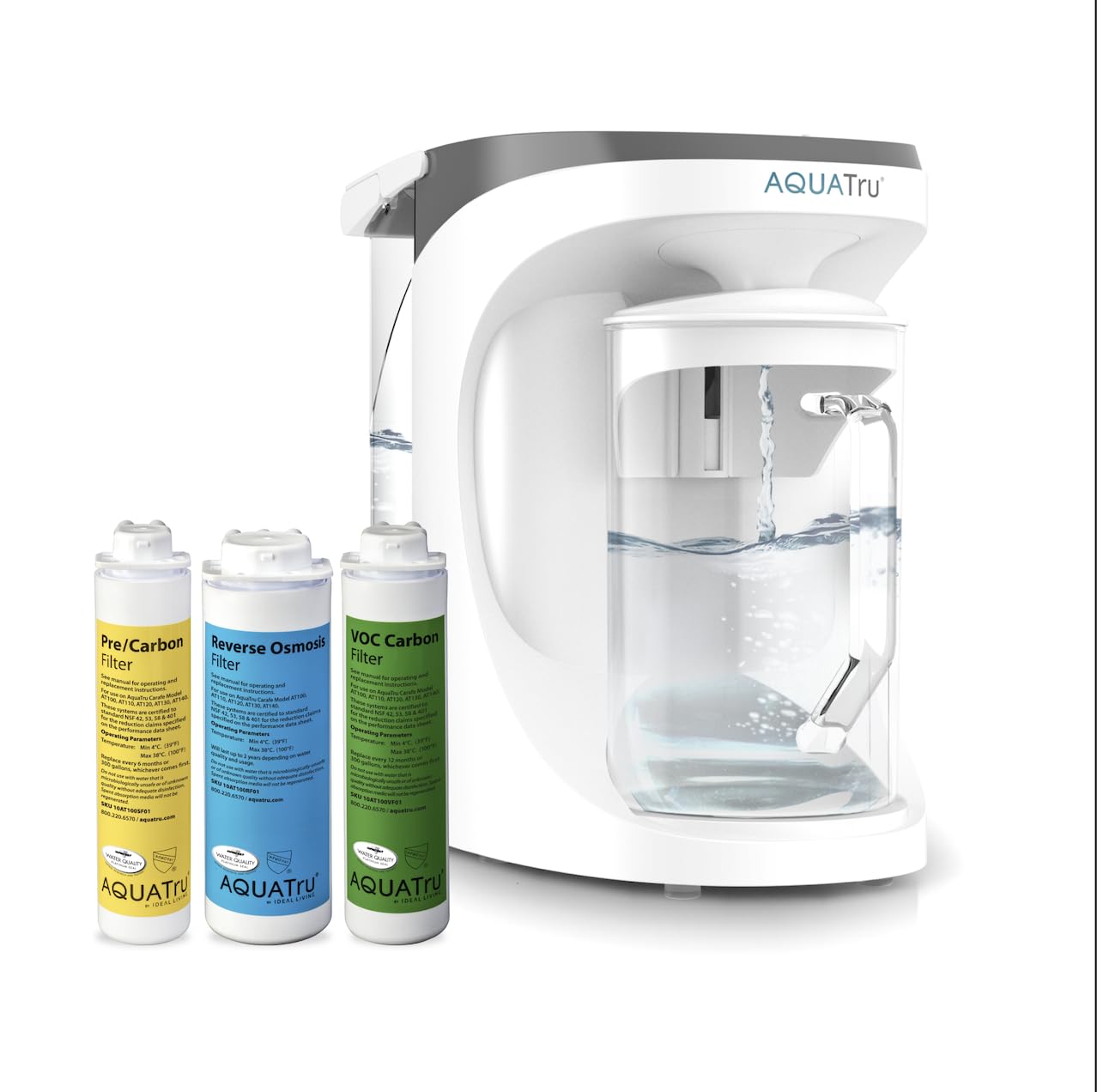
The AquaTru Carafe is the best water filter for microplastics you can buy in 2026. It’s a countertop reverse osmosis system that’s IAPMO certified to NSF/ANSI 42, 53, 58, and 401 – that last one being the critical microplastics certification. In independent testing by Water Filter Guru, it eliminated 100% of all detected contaminants, making it the only filter they’ve tested to achieve that result.
What makes the Carafe model stand out from AquaTru’s other units is the glass collection carafe. Since you’re buying this to remove plastic from your water, it defeats the purpose to store purified water in a plastic tank. The glass carafe solves that problem elegantly.
It reduces 83+ contaminants across its 4-stage filtration process (mechanical sediment filter, pre-carbon filter, RO membrane, and post-carbon filter). Setup takes about 10 minutes on any countertop – no plumbing, no tools, just plug it in. The 4:1 pure-to-drain ratio means it’s more water-efficient than many under-sink RO systems.
Price: ~$329-$379
Annual filter cost: ~$60
Best for: Anyone who wants the most effective, certified microplastic removal without installation
2. Waterdrop G3P800 (contains plastic components) – Best Under-Sink (Premium)
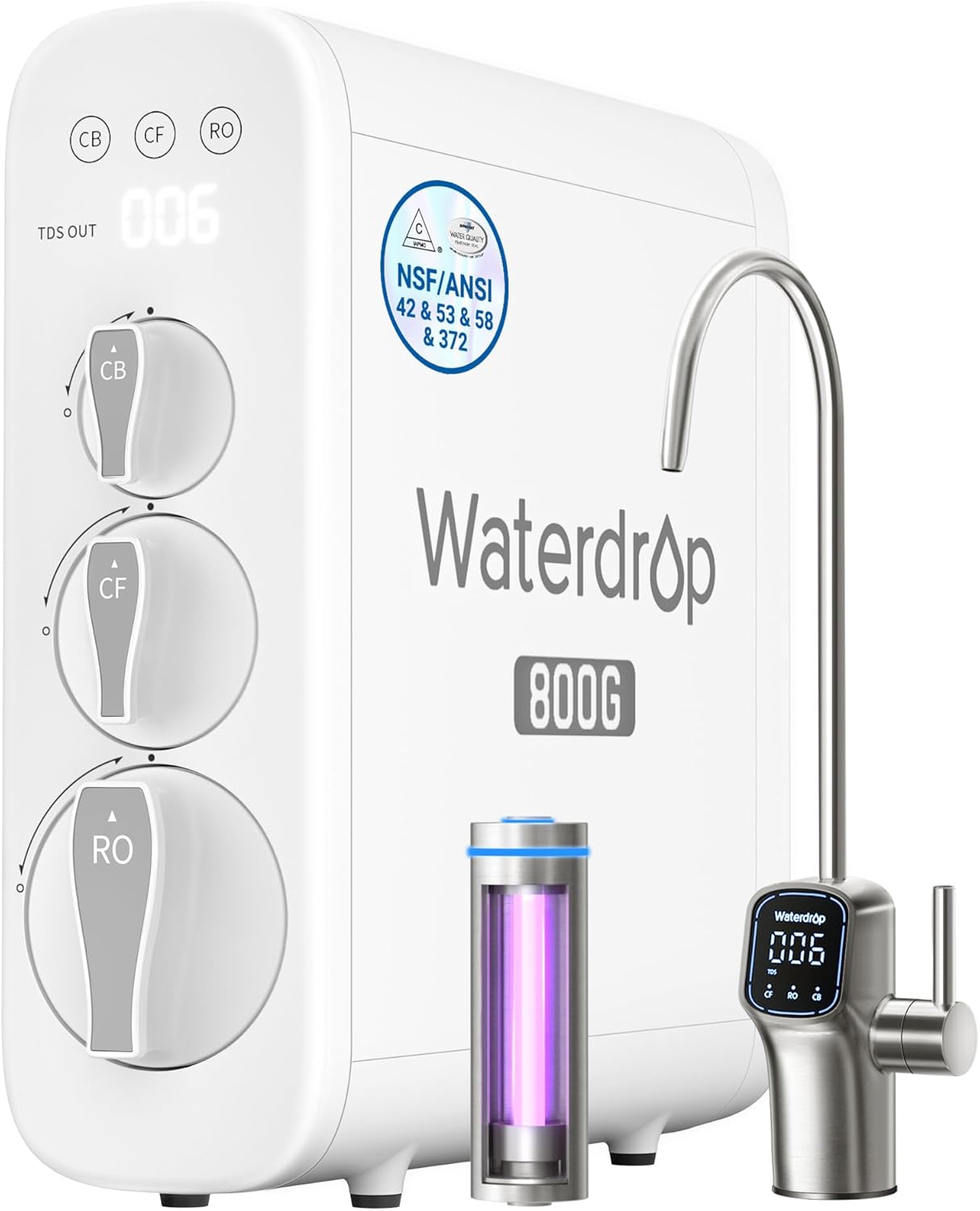
If you want a permanent, high-performance solution tucked under your sink, the Waterdrop G3P800 is the one to get. This tankless reverse osmosis system delivers an impressive 800 gallons per day, which means you’ll never wait for filtered water. It fills a glass in about 12 seconds.
The G3P800 is NSF/ANSI 42, 53, 58, and 372 certified. Its RO membrane filters down to 0.0001 microns – far smaller than any microplastic particle. The 3:1 pure-to-drain ratio makes it one of the most water-efficient RO systems available, and the tankless design saves valuable under-sink space while eliminating the risk of bacterial growth in a storage tank.
The smart LED faucet shows filter life in real time, so you know exactly when replacements are needed. Installation requires basic plumbing skills and access to an electrical outlet under the sink, but most handy homeowners can handle it in under an hour.
Price: ~$699-$999
Annual filter cost: ~$80-$120
Best for: Homeowners who want high-flow, permanent RO filtration
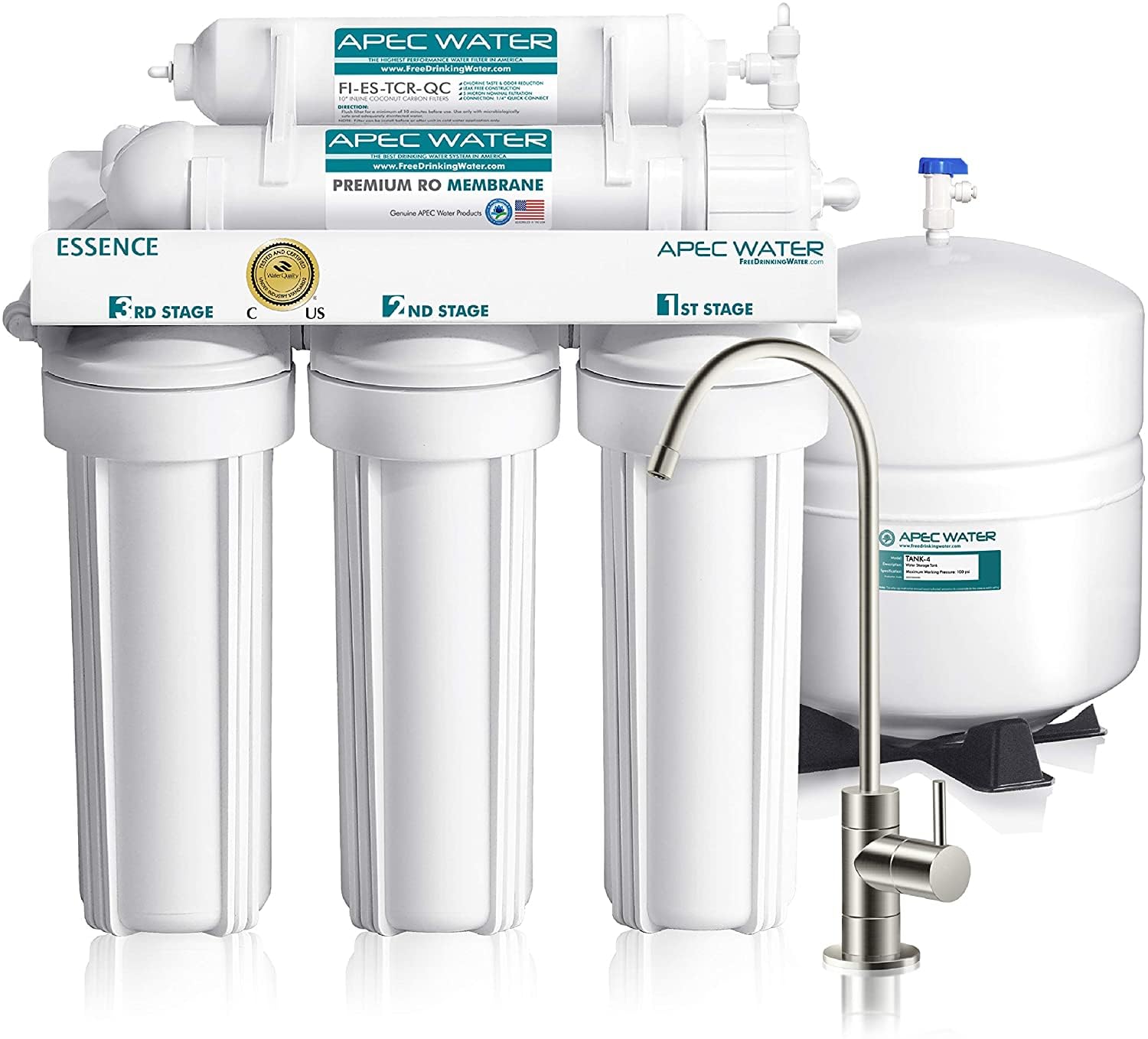
3. APEC ROES-50 (plastic filter housings) – Best Under-Sink Value
The APEC ROES-50 has been one of the most popular under-sink reverse osmosis systems on Amazon for years, and for good reason. It delivers legitimate 5-stage RO filtration at a price that undercuts most competitors by hundreds of dollars.
The five stages include three pre-filters (sediment, carbon block, and another carbon block), an RO membrane, and a final polishing coconut carbon filter. It’s WQA certified and removes up to 99% of contaminants including TDS, chlorine, fluoride, arsenic, lead, and – crucially – particles as small as the RO membrane allows (0.0001 microns), which captures microplastics effectively.
The trade-off for the lower price? It’s a tank-based system (slower flow than tankless models), and the output is 50 GPD compared to the Waterdrop’s 800 GPD. For a household of 1-4 people, that’s perfectly adequate. APEC is a US-based company with excellent customer support and a long track record.
Price: ~$170-$230
Annual filter cost: ~$40-$50
Best for: Budget-conscious homeowners who want full RO protection
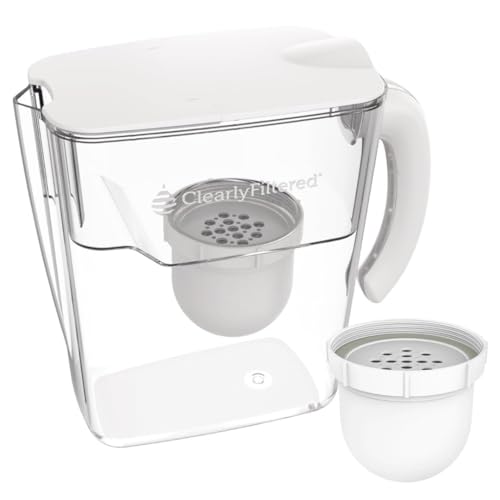
4. Clearly Filtered Water Pitcher (glass-lined reservoir, plastic body) – Best Pitcher Filter
If a full RO system isn’t in the cards, the Clearly Filtered Pitcher is the best pitcher-style filter for microplastics. It uses a proprietary “Affinity Filtration” technology that targets 365+ contaminants including 99.9% of microplastics, 99.5% of PFAS, 99.3% of lead, and 99.5% of fluoride.
Those numbers are independently tested and backed by third-party lab results. For a gravity-fed pitcher filter, that’s remarkable performance. The pitcher holds 10 cups and the filter lasts approximately 100 gallons (about 4 months for average use). The body is made from medical-grade, BPA/BPS-free plastic that’s 100% non-leaching.
The main downside? Filtering is slow – expect to wait 15-20 minutes for a full pitcher. And at ~$90, it costs more upfront than a basic Brita. But when you compare the contaminant removal, the Clearly Filtered is in a completely different league.
Price: ~$80-$100
Annual filter cost: ~$135-$180 (3 replacement filters per year)
Best for: People who want serious filtration in a simple, no-install pitcher format
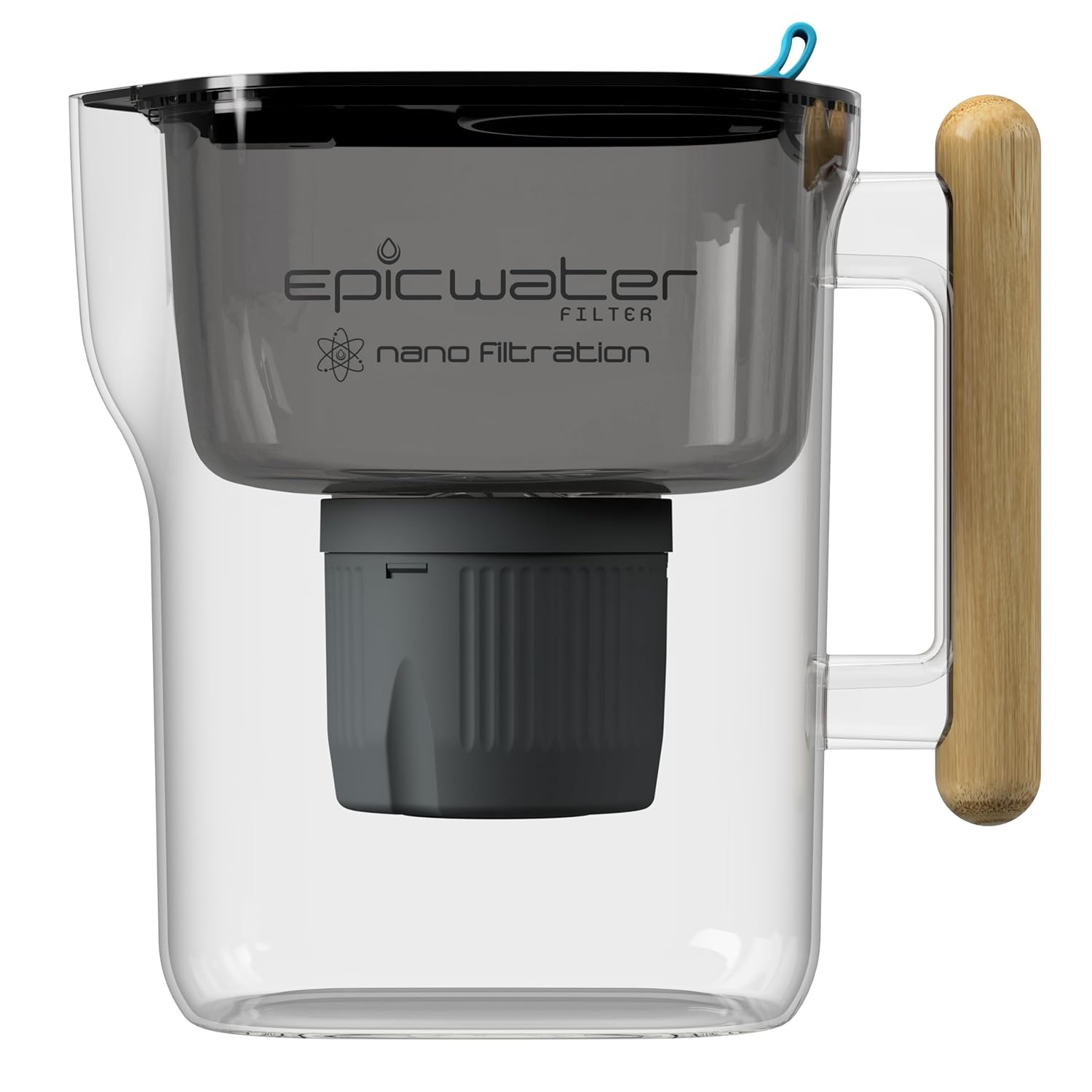
5. Epic Nano Water Filter Pitcher (plastic pitcher body) – Best Budget Option
The Epic Nano is the best budget-friendly option for microplastic removal. It uses nanofiltration technology to remove over 70 contaminants including microplastics, bacteria, viruses, PFAS, lead, and chlorine. It’s independently tested against NSF Standards 42, 53, 401, P231, and P473.
At around $55-$80 for the pitcher (which includes one filter), and with each filter lasting approximately 150 gallons (3-4 months), the ongoing cost works out to roughly $0.33 per gallon. That’s significantly cheaper than bottled water and competitive with other premium pitchers. The 10-cup capacity is enough for most households’ daily drinking needs.
Epic also offers a lifetime warranty on the pitcher itself, which is almost unheard of in this category. The bamboo lid adds a nice aesthetic touch that sets it apart from the sea of plastic pitchers. It filters faster than the Clearly Filtered, though it targets fewer total contaminants.
Price: ~$55-$80
Annual filter cost: ~$100-$150
Best for: Budget-conscious buyers, students, and anyone wanting affordable microplastic protection
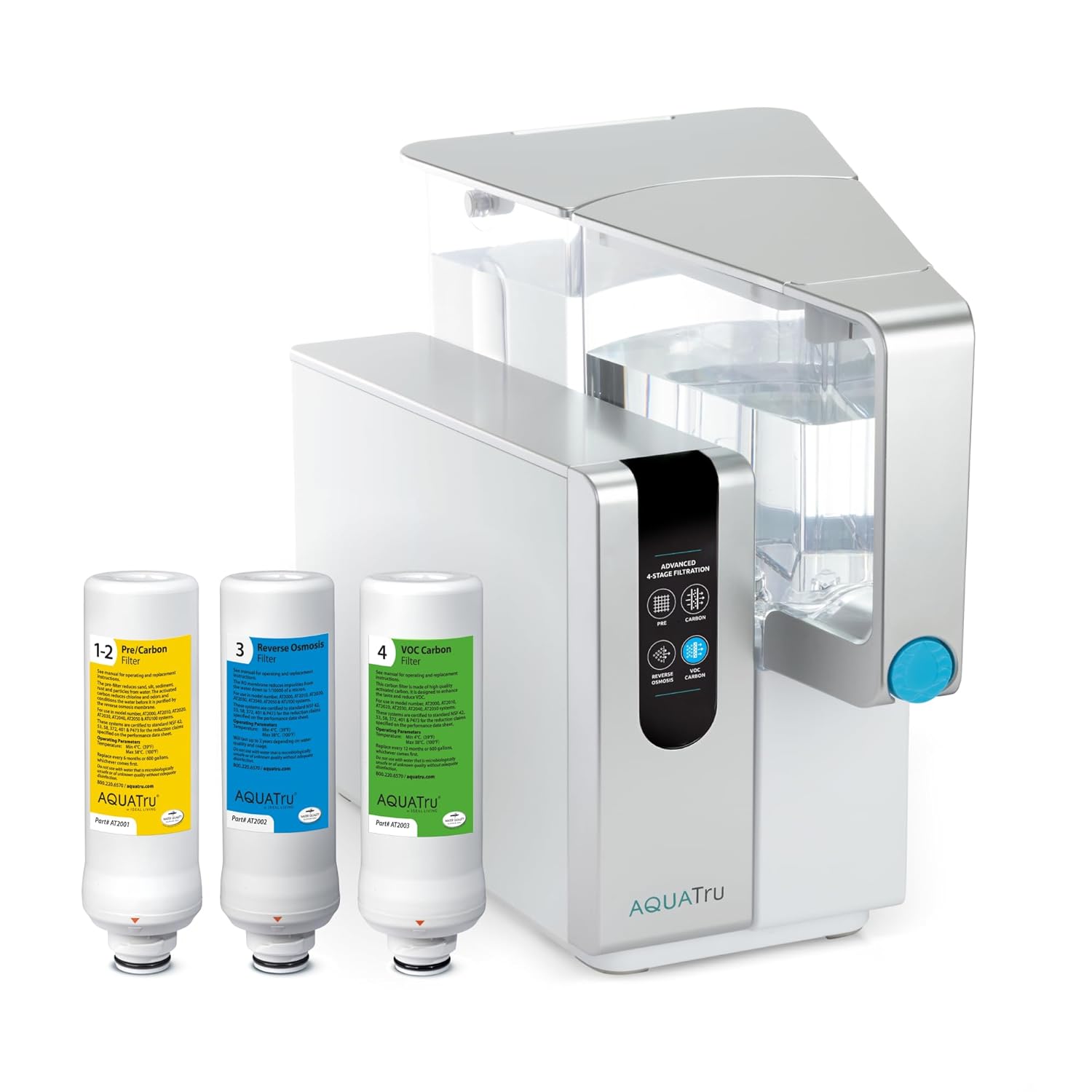
6. AquaTru Classic (plastic tank – unlike the glass Carafe) – Best for Renters (No Installation)
The AquaTru Classic shares the same certified 4-stage reverse osmosis technology as our #1 pick (the Carafe), but in a larger format with an integrated plastic collection tank. Like the Carafe, it’s IAPMO certified to NSF/ANSI 42, 53, 58, and 401 for microplastics reduction, and removes 84+ contaminants.
Why choose this over the Carafe? The Classic has a larger water storage capacity, making it better suited for households of 2+ people who go through water quickly. The newer smart-connected model also connects to an app that tracks filter life and water usage.
The real selling point for renters is the zero-installation requirement. No plumbing modifications, no landlord permission needed. Just place it on your counter, plug it in, and you have RO-quality water. When you move, it moves with you.
Price: ~$375-$449
Annual filter cost: ~$60
Best for: Renters, people who move frequently, larger households wanting countertop RO
Quick Comparison Table
| Filter | Type | Price Range | Microplastic Cert. | Annual Filter Cost | Installation |
|---|---|---|---|---|---|
| AquaTru Carafe | Countertop RO | $329-$379 | NSF 401 ✅ | ~$60 | None |
| Waterdrop G3P800 | Under-Sink RO | $699-$999 | NSF 42/53/58 ✅ | ~$80-$120 | Under-sink |
| APEC ROES-50 | Under-Sink RO | $170-$230 | WQA Certified ✅ | ~$40-$50 | Under-sink |
| Clearly Filtered Pitcher | Pitcher | $80-$100 | Lab-Tested ✅ | ~$135-$180 | None |
| Epic Nano | Pitcher | $55-$80 | Tested to NSF 401 ✅ | ~$100-$150 | None |
| AquaTru Classic | Countertop RO | $375-$449 | NSF 401 ✅ | ~$60 | None |
Filter Maintenance and Replacement Costs
The upfront price is only part of the equation. Here’s what you’ll actually spend over time:
Reverse osmosis systems (AquaTru, Waterdrop, APEC) typically need filter replacements every 6-12 months for pre/post filters and every 2-3 years for the RO membrane. Annual costs run $40-$120 depending on the system. The AquaTru models are on the lower end (~$60/year), while the Waterdrop G3P800 runs a bit higher due to its proprietary filter cartridges.
Pitcher filters need more frequent replacement – typically every 2-4 months (100-150 gallons). The Clearly Filtered replacement filters run about $45-$60 each, so you’re looking at $135-$180 per year. Epic Nano filters cost around $33-$53 each, working out to roughly $100-$150 annually.
When you factor in the total cost of ownership over 3 years, the APEC ROES-50 is actually the cheapest option: around $200 upfront plus ~$120-$150 in filters = roughly $320-$350 total. Pitcher filters cost less upfront but add up faster because of frequent replacements.
One often-overlooked cost with RO systems: they produce wastewater. The APEC ROES-50 has a roughly 1:3 ratio (1 gallon of pure water for every 3 gallons of wastewater), while the more efficient AquaTru Carafe achieves a 4:1 pure-to-drain ratio. The Waterdrop G3P800 manages 3:1. If water costs are a concern, efficiency matters.
How to Choose the Right Filter for You
Still not sure which one to pick? Here’s a simple decision framework:
You own your home and want the best protection: Go with the Waterdrop G3P800 (under-sink) or the AquaTru Carafe (countertop). Both offer excellent RO filtration with certifications to back it up.
You’re on a budget but want RO quality: The APEC ROES-50 delivers real reverse osmosis filtration for under $230. You sacrifice some speed and convenience, but the water quality is comparable.
You’re a renter or want something portable: The AquaTru Classic or AquaTru Carafe need no installation at all. For even simpler, the Clearly Filtered Pitcher goes wherever you go.
You want the simplest, most affordable option: Start with the Epic Nano Pitcher. It’s under $80, requires zero setup, and provides meaningful microplastic reduction. You can always upgrade later.
Related Articles
- Is Microwaving Plastic Safe? What Science Actually Says in 2026
- Microplastics in Tea Bags: Which Brands Are Safe?
- BPA-Free Water Bottles: Are They Actually Safe? The Uncomfortable Truth
- Best Plastic-Free Water Filters in 2026
- Are Plastic Cutting Boards Safe?
Disclaimer: This article is for informational purposes only and does not constitute medical or professional advice. Product recommendations are based on publicly available research, certifications, and independent testing data. We make every effort to keep information accurate and up to date, but prices and product availability may change. This post contains affiliate links, meaning we may earn a small commission if you purchase through our links, at no additional cost to you. This helps support No Plastic Living and allows us to continue producing science-backed content. We only recommend products we genuinely believe are worth your consideration.