Updated October 2026
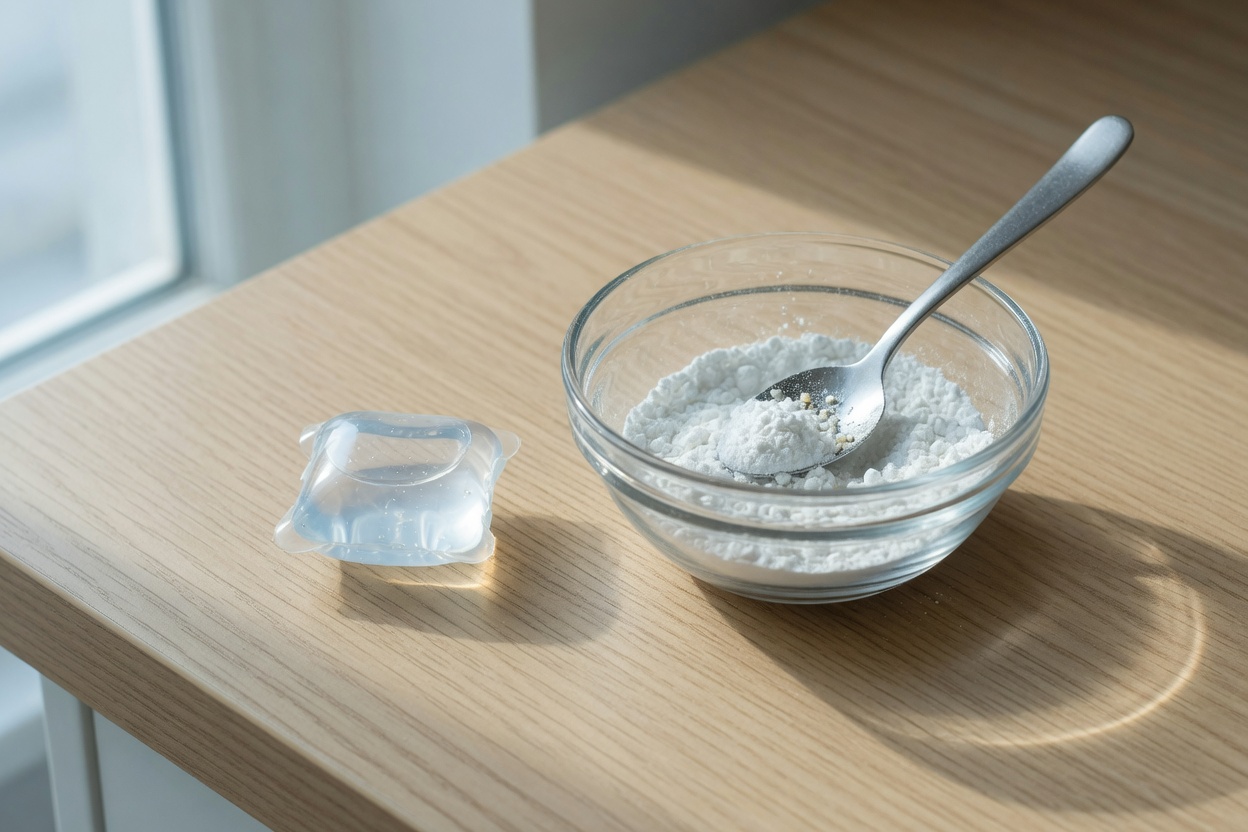
A laundry pod or a dishwasher pod is a dose of detergent inside a plastic film. The film is polyvinyl alcohol, also called PVA or PVOH. It is built to dissolve in the wash. Dissolved is not the same thing as plastic-free. The argument in 2026 is about what a treatment plant does with that dissolved polymer. You do not have to settle the argument to stop buying the film.
The skin is polyvinyl alcohol
You can see the object. A laundry pod, a dishwasher pac, a laundry sheet: if the dose is a clear or colored skin you do not peel off, that skin is the polymer. Water gets between the chains and the packet opens in the machine. You do not throw a wrapper in the trash. You send the polymer out with the wash water.
The bottle you did not buy is a real piece of plastic you skipped. The skin is the plastic you still used. One of those facts does not cancel the other.
Polyvinyl alcohol is a synthetic polymer. The grades in detergent film are partly hydrolyzed, often around 88 percent. That percent is a chemistry spec, not a recycling code. It is not polypropylene. It is not a plant plastic. “Biodegradable” on the box is a claim about a later step, after the film has already dissolved.
Dissolved is not gone
Sugar dissolves. This film dissolves too. Sugar is not a plastic. PVA is. Once it is in the water it is no longer a packet you can hold. It is still the polymer, in solution, until something breaks the chains.
The wash cycle only shows you the first step. The packet disappears. That is the product working as designed. It is not a measurement of the treatment plant downtown, and it is not a measurement of the sludge that plant sends out later.
What the 2021 model said
In June 2021, Charles Rolsky and Varun Kelkar published a model in the International Journal of Environmental Research and Public Health. They estimated about 17,200 metric tons a year of PVA from US laundry and dish pods, give or take 5,000, and about 10,500, give or take 3,000, reaching wastewater treatment plants. Once they folded older degradation studies into the model, about 61 percent of the PVA left through sludge and about 15.7 percent left through the treated water.
Arizona State’s writeup summed the same work as as much as 75 percent going untreated, about 8,000 tons a year. The paper’s split is the number to repeat. The 75 percent line is the newsroom’s.
Read the method before you repeat either number. They weighed pods, surveyed buyers, and applied older lab degradation rates to a sketch of a typical US plant. They did not sample pod film at treatment plants. The paper’s own point is that the bacteria which break PVA down are not common in ordinary plants, and that sludge already adapted to PVA degrades it much faster than sludge that is not.
The research was funded in part by Blueland. The authors say the funder did not design the study or write the paper. Blueland sells tablets that skip this film, and in January 2023 Blueland led a petition asking the EPA to restrict the chemistry. Rolsky’s byline on the paper also lists Plastic Oceans International, one of the groups on that petition.
The biodegradation tests
The American Cleaning Institute, the trade group for the companies that sell the pods, says detergent-grade PVA is made to dissolve and then biodegrade in a normal treatment plant, and that it does not become microplastic. That page is the industry answer to the 2021 model.
In 2024, Kathleen McDonough and colleagues at Procter & Gamble published a wastewater simulation in Integrated Environmental Assessment and Management. They ran an OECD 303A test on PVOH 18-88, a grade used in detergent film. During the plateau, removal they attributed to biodegradation averaged 97.4 percent, give or take 7.1. The authors report a range of 88 to 116 percent. A dissolved-carbon test can print over 100 percent when the blank moves. That is not a claim that the plant destroyed more polymer than it received. In the algae, invertebrate, and fish-embryo tests in that paper, the effect concentrations sat above 1,000 mg/L.
That is a lab plant running one grade of polymer. It is not a census of every US facility. A high removal in the simulation does not erase the 2021 model, and the 2021 model does not erase the simulation. They asked different questions with different methods, and each side has a company in the room.
What EPA did in 2023
On January 26, 2023, Blueland, Plastic Pollution Coalition, and other groups petitioned the EPA. They wanted required testing of the PVA used in pods and sheets, and they wanted PVA moved off the green circle on the Safer Chemical Ingredients List until that testing was done.
The agency signed the denial on April 21, 2023. The Federal Register notice is April 27, 2023 (88 FR 25590). EPA said the petition did not show that existing information was too thin to judge the risk, and did not show that the PVA structures allowed in Safer Choice products fail that program’s criteria. The petition’s support, in the agency’s account, leaned on a persistence estimate and on microplastic studies, rather than on the soluble PVA used in those certified products. Only some PVA structures are on the list.
EPA’s denial letter is the short version. The denial is not a lab report that every pod film vanishes in your city’s plant. It is the regulator saying the petition did not clear the bar to force new testing or to pull the Safer Choice mark.
What to use instead
Skip the skin.
Laundry powder: a scoop, not a packet. The SLS-free pick already on this site is Molly’s Suds Original powder, and the ingredient job for that powder is on the laundry detergent without SLS page. This page only cares that the dose is not a film. The bag it ships in can still be plastic. One bag is not one film per load. Synthetics still shed in the wash. That is microplastics in laundry.
Dishwasher powder to check: Molly’s Suds unscented dishwasher powder, 60 loads. The Amazon panel for that listing currently includes the line “PVOH (water-soluble film).” The directions on the same panel tell you to use a tablespoon of powder. Those two lines do not describe the same object. Open the pouch. If you have loose powder and the printed panel has no polyvinyl alcohol, you skipped the film. If you have skins, it belongs with the pods.
Molly’s Suds Dishwasher Powder | Clean Dishwasher Detergent, Cuts Grease & Rinses Clean (Residue-Free) for Sparkling Dishes | 60 Loads (Unscented). Read the pouch. The listing and the pouch have already disagreed once.
Laundry sheets are the film in a flat shape. Do not swap a pod for a sheet and call it done.
A pressed tablet with no skin also skips the film. “Plastic-free” on that box still has to survive the ingredient panel. PVA used as a binder is still PVA.
The bottle of dish soap at the sink is a different purchase. What to wash with there is in dish soap.
The Bottom Line
A laundry or dishwasher pod in 2026 is detergent inside polyvinyl alcohol. The film is plastic that is designed to dissolve. Dissolved is not a measurement of what your treatment plant does next. A 2021 model, funded in part by a company that sells an alternative, says most of the PVA leaves the plant in sludge or water. A 2024 simulation from Procter & Gamble says a detergent-grade film biodegrades in a lab plant. EPA in 2023 left it on Safer Choice. If you do not want the film, buy a powder and read the panel.